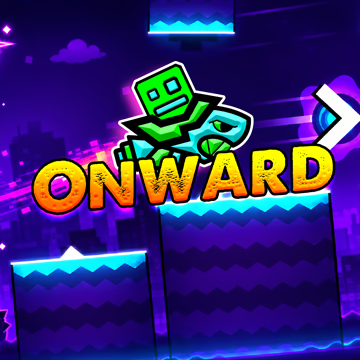
Geometry Dash Onward is a fast rhythm platformer that tests reflexes with sync driven stages. Hit every beat to unlock skins and climb the leaderboard.
About Geometry Dash Onward
Some games pull players in with huge worlds and complicated stories, while others need nothing more than a few geometric shapes, a catchy beat, and one perfectly timed tap. Geometry Dash Onward was built around that simple idea: keeping the familiar feel of the Geometry Dash series while creating a constantly changing journey where every moment puts players in front of a new decision.
Created by Destriv, Onward is a Hard-difficulty rhythm platformer where quick reflexes and precise control are everything. The character keeps moving forward while a series of portals changes its form, speed, or movement mechanics. From Cube and Mini Cube to Ball, Robot, Ship, and UFO, every transformation feels like entering a new chapter of the journey, forcing players to adapt before the next obstacle appears.
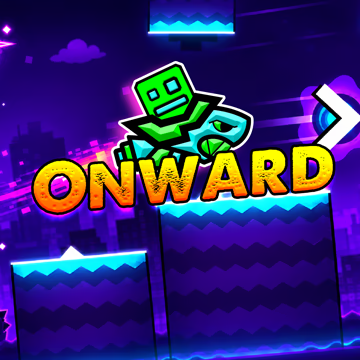
Geometry Dash Onward is a fan-made platformer game
What Style Does Geometry Dash Onward Follow?
Onward embraces the rhythm-based arcade platformer style with the signature geometric design associated with Geometry Dash. Here, visuals are more than just eye candy. They directly help players read the level and understand what is coming next. Platforms, spikes, buzzsaws, pillars, and portals are clearly placed, giving players visual cues for when to jump, switch gravity, or adjust their movement.
The game uses bold colors and sharp geometric shapes to create an energetic arcade atmosphere. Strong contrast between the character, obstacles, and background keeps the path easy to read even when the pace starts picking up. At the same time, the fast-moving effects and vibrant visuals can become part of the challenge, pushing players to focus on their character and the path ahead instead of getting distracted by everything happening on screen.
Music also plays an important role. The catchy rhythm is not simply background audio. It can help players find the right timing for their moves. After a few attempts, players may start to recognize the connection between a section of the track, a jump, and an upcoming gameplay transition.
How to Play Geometry Dash Onward
What Is the Main Goal?
The goal of Onward is straightforward: guide your character through the entire level and reach the finish without hitting any obstacles. Along the way, players must constantly adapt to changes in speed, size, gravity, and character form. The level also features three large coins, giving players an extra challenge and another reason to replay the stage in search of more precise routes.
Controls Similar to Geometry Dash Polargeist
The controls are intentionally simple, offering a familiar experience similar to Geometry Dash Polargeist. On PC, players can left-click or press W to jump or control the character while flying. On mobile devices, simply tap the screen to interact.
That simplicity is what makes Onward challenging. You do not need to memorize a complicated control scheme, but you do need to master the timing of a single action. When the speed changes or the character switches modes, a click that comes just a fraction of a second too early can be the difference between continuing your run and starting all over again.
Tips for New Players
- Look ahead: Do not focus only on your character. Watch upcoming platforms, spikes, and portals so you can prepare your next move.
- Learn each portal: Portals can change your character, speed, or gravity, so try to remember the order of each transition.
- Avoid unnecessary clicks: Rapid tapping can throw off your rhythm. Make every input count.
- Do not give up after failing: Replaying difficult sections helps you memorize the timing and turn those early mistakes into natural muscle memory.
Geometry Dash Onward does not tell its story through dialogue or complicated characters. Its story is created through the journey each player takes with every attempt. Every collision teaches you something, every new record shows how far you have come, and reaching the finish becomes a rewarding payoff for the patience and persistence behind the screen.