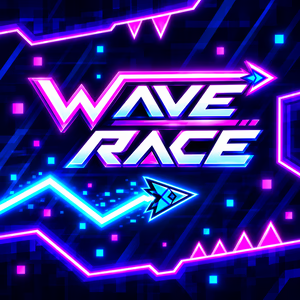
Take on Wave Race and master every rise and descent as your arrow speeds through geometric tunnels packed with spikes, walls, gears, and narrow passages.
Overview of Wave Race
Some games begin with a huge idea, while others come from a much simpler question: Can a game built around just one control still create a challenge that makes players want to try again and again? Wave Race was designed around that idea.
Instead of putting players on a traditional racetrack, Wave Race places a small arrow inside a constantly shifting world of geometric tunnels. There are no complicated controls or long lists of skills to memorize. Players only need to decide when to make the arrow rise and when to let it descend. Behind that simple mechanic, however, lies a demanding test of reflexes, rhythm, and timing.
Wave Race falls into the 2D arcade, skill, and obstacle-dodging genres. Every failure is designed to teach players something new. The core idea is to create an experience that is easy to pick up but challenging to master, where even the smallest movement can determine how far the run goes.
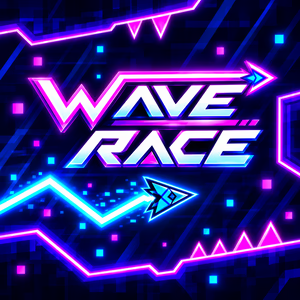
Master Wave Race by controlling your arrow's height with perfect timin
Style of Wave Race
Wave Race uses a 2D arcade style with a side-scrolling perspective, keeping the focus firmly on the arrow's movement and the obstacles ahead. This design makes the gameplay easy to understand from the very first moment. Players do not have to spend time learning a complicated map or interface. Instead, their attention goes straight to the path in front of them.
Visually, Wave Race uses contrasting colors to clearly separate the arrow, its flight path, and the surrounding environment. The arrow's bright appearance makes it easy to track as it moves through dense geometric tunnels. Meanwhile, the background and obstacles follow a clean geometric style, creating the feeling of a constantly shifting digital maze.
This minimalist visual approach is not just about looks. It also supports the gameplay. As the speed picks up, players need to recognize openings and hazards within seconds. A clear visual design makes every movement easier to read, giving players just enough information to react before it's too late.
How to Play Wave Race
Main Objective
The goal of Wave Race is simple: guide the arrow through the tunnel, avoid obstacles, and reach the finish without crashing.
Controls
The entire control system revolves around managing the arrow's height:
-
Rise: Hold Mouse / W / Spacebar to make the arrow fly upward.
-
Descend: Release the input to let the arrow move downward.
-
Pause: Press P to pause the game.
The real challenge comes from knowing when to use each action. Holding the button for too long can send the arrow into the ceiling, while releasing too early can make it drop into an obstacle below. Every press and release becomes part of a rhythm. The better players understand that rhythm, the more precise their flight becomes.
Obstacle System
Wave Race turns the path ahead into a series of geometric challenges, with each obstacle demanding a different approach:
-
Spikes: Clusters of spikes force players to find the right height to pass through safely.
-
Walls: Walls narrow the available space and require precise adjustments.
-
Rotating Gears: Moving gears make timing even more important.
-
Narrow Gaps: Tight openings test how carefully players can control each movement.
-
Slopes: Sloped sections change the flight path and require players to react early.
When these elements appear together, Wave Race becomes more than a simple obstacle-dodging game. It becomes a test of anticipation, where reading the path ahead can be just as important as reacting quickly.
What Role Do Checkpoints Play?
Checkpoints are an important part of the way Wave Race is designed. The game expects players to fail several times before they fully understand a difficult section. Every crash is therefore more than a setback. It gives players a chance to remember where the danger was and adjust their approach.
Instead of forcing players to repeat the entire journey after every mistake, checkpoints make the learning process more manageable. Players can focus on the section that gave them trouble, experiment with different hold-and-release timings, and gradually turn a dangerous stretch into familiar territory.
This is where the true nature of Wave Race becomes clear. Winning is not only about having fast reflexes. It is also about learning from every mistake and using that knowledge to make the next attempt better.
Conclusion
Wave Race is built around a simple philosophy: easy to play, but challenging to master. A single control can create countless situations as speed, distance, and obstacles constantly change around the player.
For players who enjoy precise controls, rhythm-based movement, and overcoming challenges that seem impossible at first, Geometry Dash Polargeist is another game worth checking out. It shares one of Wave Race's most appealing qualities: the controls look simple at first, but going further requires players to read obstacles, master their timing, and turn every failed attempt into experience for the next run.